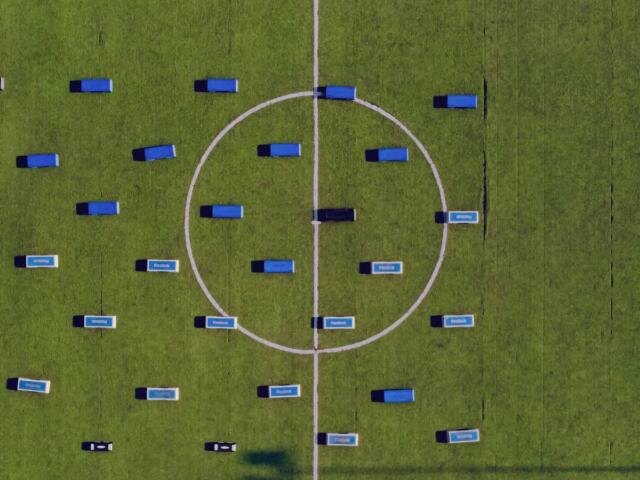
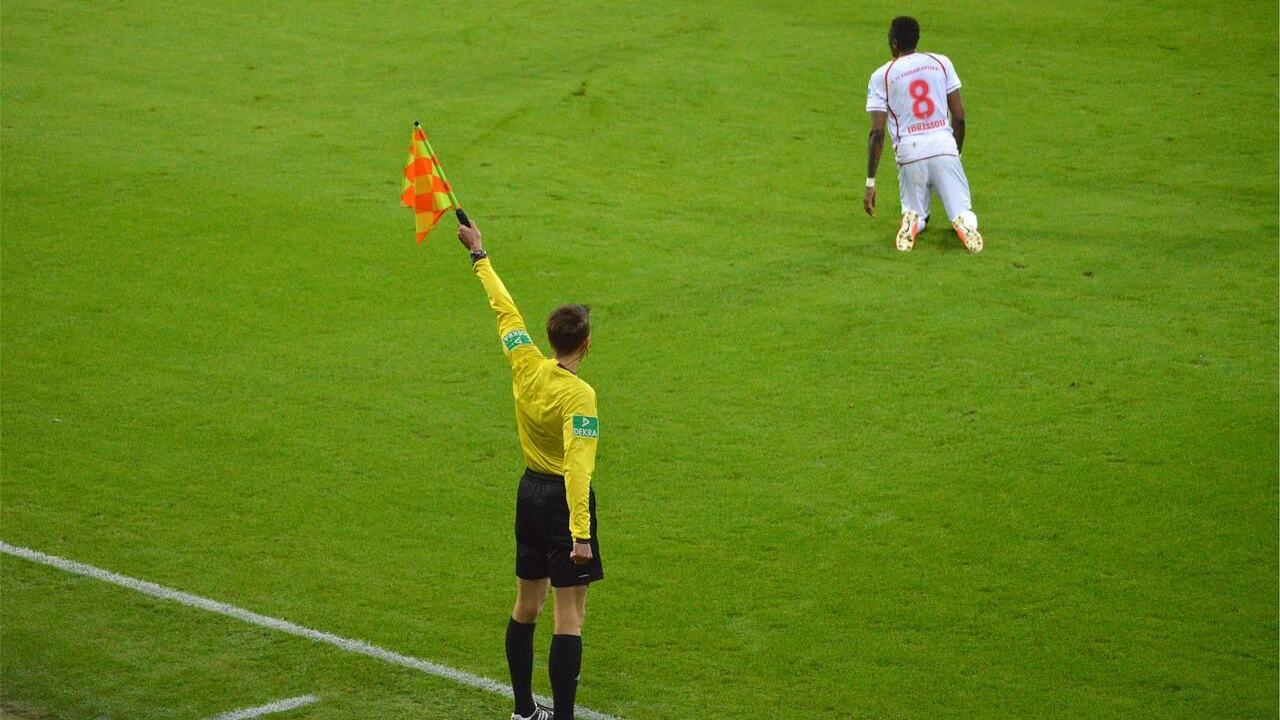
Wondering what is offside in soccer and why the flag keeps going up? A player is offside when they are nearer the opponents’ goal line than the ball and the second-last defender, and then get involved in play.
New to the sport or just playing soccer games on your phone? This guide walks through the rule in plain language.
| Item | Value |
|---|---|
| Rulebook edition checked | IFAB Laws of the Game 2026-27 |
| Law that covers offside | Law 11 |
| Being in an offside position | Not an offence in itself |
| Level with the second-last opponent | Not offside |
| Penalty for an offside offence | Indirect free kick where the offence occurred |
| Restarts with no offside offence | Goal kick, throw-in, corner kick |
These figures come from The FA’s Law 11 page. Rules can change between seasons, so check the source before you rely on them.
The offside rule in plain words
Offside exists to stop attackers from simply waiting next to the goal for a long pass. The rule keeps attackers and defenders in a fair contest for space.
The key idea is that position alone is not a foul. The Laws state: “It is not an offence to be in an offside position.” A player is only punished if they take part in the play afterwards.
So the rule has two separate questions. First, was the attacker in an offside position when a team-mate played the ball? Second, did that attacker then become involved in active play?
When is a player in an offside position?
The Laws set out the test: “A player is in an offside position if: any part of the head, body or feet is in the opponents’ half (excluding the halfway line) and any part of the head, body or feet is nearer to the opponents’ goal line than both the ball and the second-last opponent.”
In practice, check these things at the moment the pass is played:
- The attacker must be in the opponents’ half, not counting the halfway line.
- Some part of their head, body or feet must be closer to the goal line than the ball.
- That same part must also be closer than the second-last opponent, who is often the last defender because the goalkeeper usually counts as the last opponent.
Hands and arms do not count. The Laws say: “The hands and arms of all players, including the goalkeepers, are not considered.”
Level means onside
If the attacker is exactly even with a defender, the benefit goes to the attacker. The Laws say a player is not in an offside position if “level with the: second-last opponent or last two opponents”.
This is why close calls are often decided by tiny margins. A shoulder or a toe ahead of the defender is enough to be offside, while being even is not.

What counts as active play?
Standing in an offside position is only penalised when the player gets involved. The Laws describe it this way: a player “is only penalised on becoming involved in active play by: interfering with play by playing or touching a ball passed or touched by a team-mate” or by interfering with an opponent.
Here is how that looks in typical situations:
- An attacker runs onto a through ball from an offside position and touches it: offside.
- An attacker stands offside but never touches the ball and does not affect a defender: no offence.
The Laws also deal with a defender who plays the ball on purpose. They list indicators of “deliberately played”, such as a ball that “travelled from distance and the player had a clear view of it”. A deliberate play by a defender can reset the situation, while a rebound or deflection usually does not.
When offside cannot be called
Some restarts are exempt. The Laws say: “There is no offside offence if a player receives the ball directly from: a goal kick a throw-in a corner kick”.
That means an attacker can stand close to the goal at a corner and receive the ball without breaking the rule. The exemption only applies to the first touch directly from the restart.
The Laws quoted above cover only a player who receives the ball directly from the restart.
What happens after an offside offence
The Laws state: “If an offside offence occurs, the referee awards an indirect free kick where the offence occurred, including if it is in the player’s own half of the field of play.”
An indirect free kick means the ball must touch another player before a goal can count. The defending team usually takes it, often from a spot close to where the attacker was standing.
A few more practical points help when you watch a match or play a game:
- The assistant referee raises the flag, but the referee makes the final decision.
- The position is judged when the ball is played, not when the attacker receives it.
- Defenders can step up together to leave attackers offside, a tactic known as the offside trap.
The offside trap depends heavily on how a team lines up at the back, which is covered in soccer formations explained.
Common offside mistakes to avoid
Beginners often assume that any attacker ahead of the ball is offside. That is not true, because the attacker must also be ahead of the second-last opponent.
Another common slip is judging the position when the ball arrives instead of when it is played. Watch the moment of the pass, then see where everyone was standing.
- Standing behind the ball is never offside, even if you are past every defender.
- Being in your own half is never an offside position.
- Being level with the second-last opponent or the last two opponents keeps you onside.
- Staying out of the play means no offence, even from an offside position.
Keeping these four checks in mind makes most decisions easy to follow, whether you watch a live match or a replay.
Offside in mobile soccer games
Many mobile games include an offside rule, though some turn it off for faster, simpler play. Check the settings menu or the tutorial to see whether flags are enabled.
If your attacker keeps getting called back, hold the run until the pass is played. Timing the sprint matters more than raw speed.
If you are still choosing a title, our list of the best soccer games for android is a good starting point. This site is independent and is not affiliated with any game, league or governing body mentioned.
Frequently asked questions
Is being offside always a foul?
Show answer
No. The Laws state that it is not an offence to be in an offside position. The offence only happens if the player becomes involved in active play.
Can a goalkeeper decide who is offside?
Show answer
The goalkeeper usually counts as one of the last two opponents, so the second-last opponent is often the last outfield defender. Any two opponents can count, though, so the goalkeeper is not required to be one of them.
Can you be offside from a throw-in?
Show answer
No, not when you take the ball straight from the throw. The same protection covers a goal kick and a corner kick.
Do arms count when judging offside?
Show answer
No, an outstretched arm can never put an attacker offside. Only the head, body and feet are measured, so a lunging arm does not change the call.